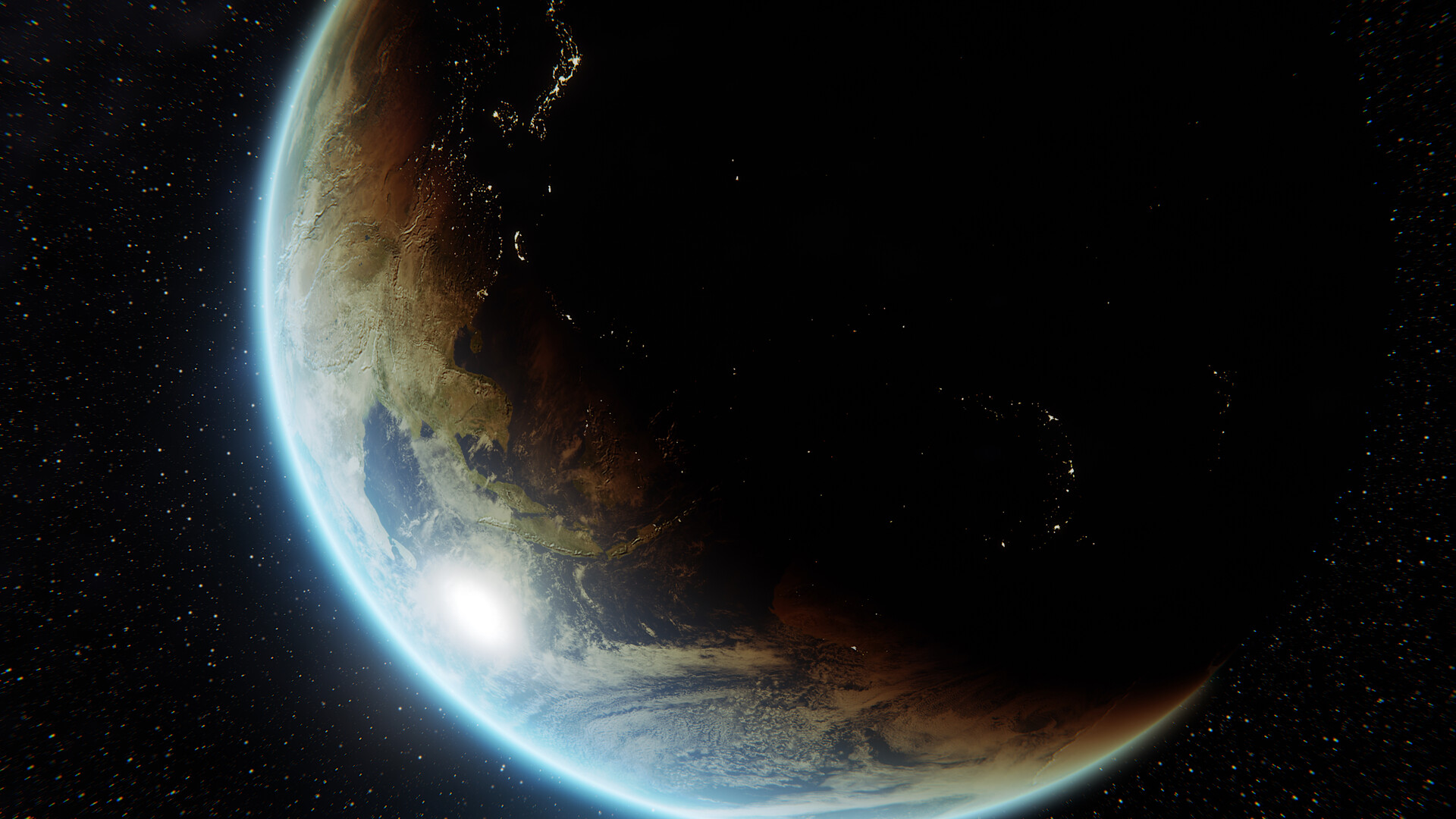
Colorful Earth
12/16/2020
Rendering the earth – from no 3D geometry. Well, technically.
I take the camera coordinates and find the intersection between orthographic rays and a sphere. From there I can sample textures, and apply lighting (lambert cosine is just the dot product between the intersection coordinate and the light direction, since the intersection coordinate is the same as the normal when the sphere is a unit sphere centered at the origin).
I can then use the lambert cosine to determine cool color effects on the horizon, use cell noise to create stars (then add different scales of stars together), use Shclick fresnel for approximating the Rayleigh/Mie spectral scattering on the earth, and raise the closest distance from the ray to the sphere (if the ray misses the sphere) to the power of -4 (and apply a few additional transformations) to get nice scattering effects outside the bounds of the earth.
Overall, this is physically based until I get to the artistic aspects, which are all only artistically tuned (atmospheric scattering, chromatically dispersive horizon colors, stars and night lights being visible, and the earth being very saturated, intensity of normal mapping, etc.).